Financing health in Nigeria: think OoP crisis, not aid crisis
Out of pocket spending in health is ten times larger than total aid to health. Shouldn't we talk more about this kind of thing in PEA?
Peter J Evans | 14 August 2026
Note: An earlier version of this article was first published on Not that Peter Evans's Substack on 11 August 2026. It was reprinted by permission from the author.
Open PEA’s latest product examines health financing in Nigeria: the money flowing into the system, and the pipes that are meant to carry it to where it delivers results.
That may sound pedestrian. But the paper surfaces some new takes on old problems, plus some lessons about politics and power in Nigeria and health more generally. It also shows the value of doing political economy analysis independently, in public and written for the mainstream.
Who actually funds health?
The headline is simple: ordinary people pay most of the Nigeria’s healthcare bill.
External partners provide about 7% of Nigeria’s total health spending. Different tiers of government provide 12%.
The maths is not difficult:
7% + 12% = 19%. Nigerian households pay nearly all the rest.
More than 70% of health spending comes directly out of people’s pockets. Much of it flows through diverse and relatively chaotic private markets. Some is also paid (officially or unofficially) in public facilities. As a result, out-of-pocket spending is roughly ten times larger than health-related aid.
Surprised?
A crisis (OoP not aid!)
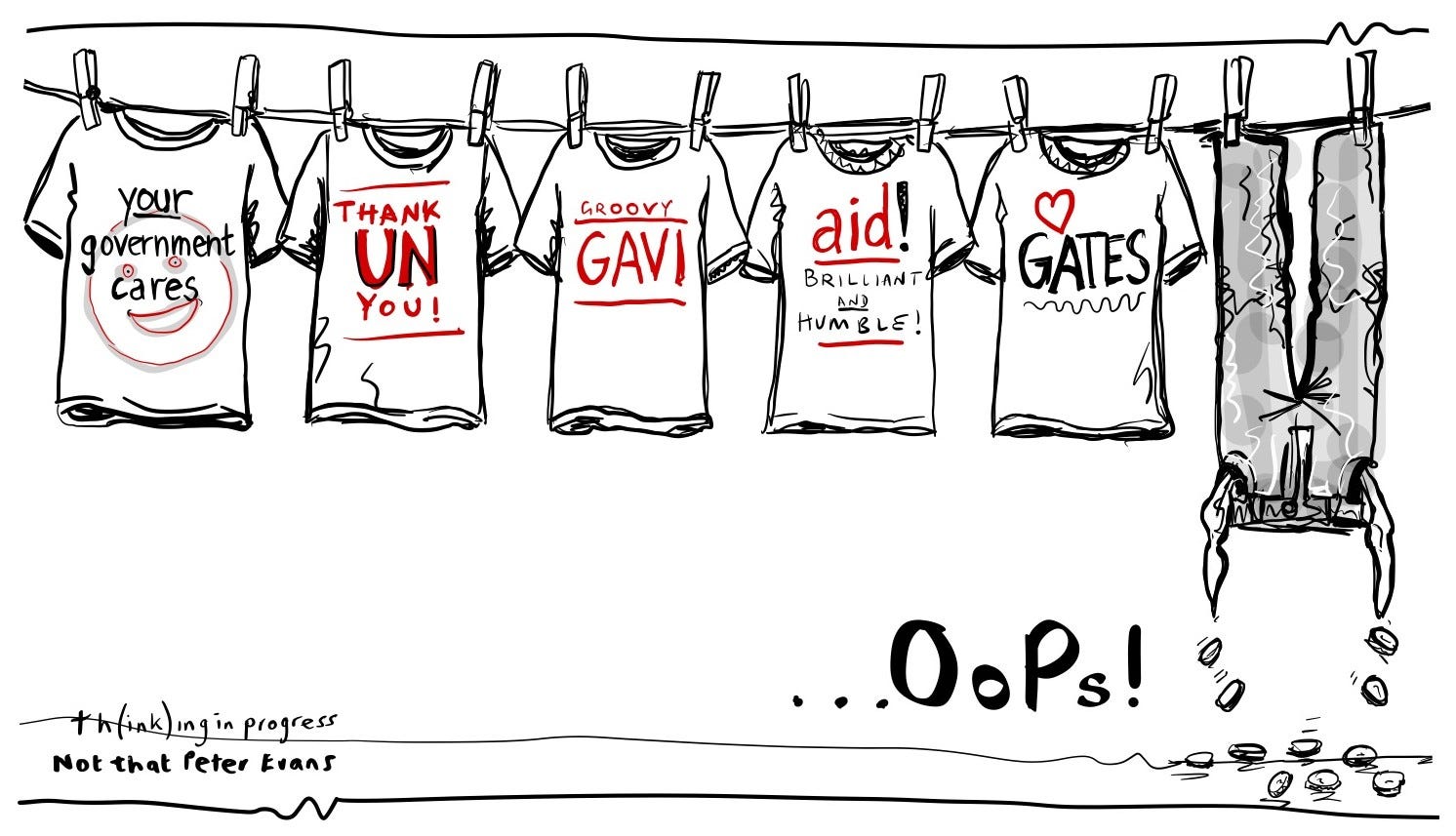
Debates around health financing are relatively quiet about this reality. OoP does not fit the narratives of the most powerful and organised players in health, their interests and incentives. We could say that national and global health elites choose to focus elsewhere – such as on the relationship between international funders and government, and the ‘aid crisis’. This focus reflects the elite bargain in health.
We propose that national policymakers and donors alike should focus more on the out-of-pocket crisis, and less on the aid crisis.
This does not mean giving up on public services, or on aid. It means bringing the largest part of the system to the centre of the analysis. Nigerians are already buying vast amounts of health care in private markets. Those markets need far more attention. We need to understand how they work, whom they serve, what they charge and how they might deliver safer and better care, outputs and outcomes.
As well as refocusing, this will also need some retooling by the dominant players. Do they have the skills and the knowhow to help understand and shape this market? (this aspect certainly stretches me!). Or do dominant narratives in health policy also reflect the types of professional skills and interests represented at the policy table?
Customer feedback (rare for PEA)
Open PEA’s readers in Nigeria and global health are telling us what they think of the product. One said that 'it shifts attention towards the lived experience of households and the realities of the wider health market.' Another that:
'Moving the spotlight off aid (7%) and onto what families pay (70%) is smart. And your point that out-of-pocket spending acts as a "pressure valve" is a good one. The system stays broken because the mess quietly works for someone.'
Spontaneous feedback is gratifying. For political economy analysis, it is also pretty rare.
Open PEA: free to roam, free to read, free to challenge
Has anyone else received unsolicited emails and DMs from strangers about sector-focused political economy analysis? We expect ‘not much’, as PEA is often private. This is one of the benefits of open-access, public-good PEA.
To be fair, there have been some good papers published on the politics of health finance in Nigeria. Some even discuss OoP, though such pieces can be quite hard to find. The scale of OoP is important enough to keep digging into, and amplifying as the true reality.
Of course, not all PEA feedback is positive. One reader told us that our product on cash versus maize in Malawi 'seems to be a roundabout way of suggesting reverting to the neoliberal policies pushed by the World Bank and others in the 1980s'.
Cue a collective ‘oof’ for the Open PEA team. Are we really like that? Eighties-style structural adjustment is hardly what we want to see in this world, but I expect we’ll get more comments like this. We do the analysis and then draw propositions for politically feasible action. Sometimes those propositions challenge our ‘priors’ (the beliefs or uncertainties that we hold before we come to our ‘data’ -or problem). Sometimes they shake our deep seated, more ideological, beliefs.
This is a point of Open PEA. Asking what is politically feasible to do is different from asking what your own convictions would like to see happen. Any organisation seeking to make change would be wise to distinguish between these two.
PEA outside the box - saying it as we see it.
Prince Agwu and I wrote the Nigeria health finance piece as an offshoot of more conventional work on health systems. That earlier work had clear terms of reference. The Open PEA product did not. Removing the commissioning constraints allowed us to say it as we saw it and so bring OoP to the fore.
This raises a broader question. If PEA is independently funded, treated as a public good and published openly – rather than commissioned by an organisation that defines the parameters, and is itself a player in the game – where does the analysis take us?
In my government days, had I commissioned PEA on health financing, I would almost certainly have focused it on the government health system. The private sector might have appeared in relation to public procurement or insurance, but the wider private market would have received little attention. Had the authors wandered into this, I might have told them to get back in lane.
The public system was where our aid pounds sat, and where my own ideological interests were fixed. I am a child of UK government education and the National Health Service. My ‘prior’ was that state health and education systems can and indeed must be made to work for everyone, everywhere in the world. Even if we have been trying and failing for decades. Try harder!
The 'if only' school of public policy
Looking back, I was a student of the 'if only' school of public policy. If only the public system worked better, outcomes would improve. Despite repeated disappointments, we had to keep trying – sometimes doing the same thing again, only more so. We wanted public systems to improve because we were, at least in part, ideologically committed to the idea that the state should provide basic services.
Open PEA can challenge such path-dependent thinking. We won’t try to push readers into an ideological camp. But by analysing outside a pre-set frame, we aim to help readers see problems in ways that they probably couldn’t from inside their own box.
The Nigeria paper does contain some hard messages for the government health system. It stresses the need to fix unglamorous but essential plumbing. Health outcomes will likely improve if budget execution, payment flows, accountability and the connections between different parts of the system get better. These basics receive less attention than new tertiary infrastructure and high-profile vertical programmes.
But it also asks policymakers and funders to think outside the public sector to help improve services where patients seek them today. This is unfamiliar territory for many in national and global health policy elites, but Nigerians would benefit greatly if they did so.
Education faced a similar reality some 15 years ago with the rise of low-cost private schools, with relatively poor people spending their own money to opt out of government education. Some experts wanted to ignore or undermine this. Others treated private schools’ emergence as proof that the state had entirely failed and that markets should be let loose.
I remember briefly feeling almost hurt about this exodus: if only these poor parents could realise how hard we were trying! I got over myself. Education in all schools needs to be better – and education policy should embrace them all. The private / public mix is here to stay.
Health policy needs to make the same adjustment. Respect citizens’ agency and choices, then ask how the services they actually use can be made safer, fairer and better. The overall answer will not be wholly public or wholly private. It lies somewhere in the messy middle: better public financing, more reliable public provision, stronger regulation and practical efforts to improve private markets.
We have another Open PEA product coming very shortly (taster here) on public–private partnerships in education that explores this middle ground. I suspect this messy public/private reality will become a recurring theme in Open PEA. Some will see us or want us to be ‘if only’ state purists, while others will want us to be, or accuse us of being, free marketeers or neoliberals. I look forward to the debate!
We’ll dig into real problems, describing the players, their incentives and the rules of the game. We’ll recognise what citizens actually do, not what we want them to do. And we’ll be prepared to amend our priors when the analysis takes us outside our usual box.
Will you?
Open PEA's product on the practical politics of health financing in Nigeria is available for free. Tell us what you think!
If Open PEA's mission resonates with you, get in touch at open.pea@bsg.ox.ac.uk.
There are three ways you can help.
Fund new Open PEAs (including training sessions) so we can continue developing practical, open-access analyses of the enduring problems holding education systems back.
Use our products in your own work and encourage others to do the same.
Share them widely to help put politics on the table in education policy and practice.