Maximise the impact of the third wave of philanthropy, with a side bet on open politics
The third wave of philanthropy is not the typical arena for political economy analysis – but should be. An ambition for audacious, transformational impact cannot afford to ignore politics.
Peter J Evans | 16 September 2026
Note: An earlier version of this article was first published on Not that Peter Evans's Substack on 15 September 2026. It was reprinted by permission from the author.
At Open PEA we apply plain-language, open-access political economy analysis (PEA) across three fronts of development finance:
- The boom: effective altruism, private philanthropy and the AI-powered third wave.
- The bust: the collapse of governmental aid and new models of effectiveness for bilateral donors and international financial institutions.
- The evergreen: low- and middle-income governments’ own revenue and debt.
Across all three, the aim is the same: bring the political constraints to growth and development out into the open so that the money works better, regardless of the source of funds.
Where have we got to?
Our products – cash vs. maize in Malawi, civil service reform in Nepal, and health finance and private participation in education in Nigeria, with 11 more in progress – have spurred good debate. They demonstrate the value of PEA that is independent, open access and tuned to de-risking investment and exposing political elephants in the room.
A common response from our readers is: ‘we knew this privately, but didn’t know how to discuss it in public.’ Our strapline, ‘put politics on the table’, is literally happening: people are bringing hard copies to policy meetings and pointing to the analysis and our practical propositions.
Each product prompts requests for more. Our next Malawi product, on the politics of exchange rates, was requested by domestic, bilateral, multilateral and philanthropic actors – they said ‘we can’t solve the maize problem until we tackle forex’. Enthusiastic users remain more vocal than prospective funders, so we still need to crack our ‘who funds public goods?’ challenge. But the audience and appetite are clear.
Our method is deliberately simple: 1. Problem; 2. Players; 3. Rules of the game; 4. State of play; 5. Propositions. These five steps also work as a participatory tool. After networking at Skoll Week and the Education World Forum, we ran one- and two-day education ‘bootcamps’ in Oxford and Nairobi. Participants brought their own knotty problems, and we helped them work through the steps to politically feasible action. Feedback was positive, and there have been requests for more.
Open PEA fills a practical gap. Professionals read deeply about the countries where they work, but that reading is often general and historical. They steep themselves in technical dimensions of their sector. But they may struggle to understand and articulate power dynamics and what these mean for effectiveness. We help with short, sharp briefs tailored to a sector or binding problem, and include clear, actionable advice for what it would take to unlock the ‘political will’ needed to do something about it.
Open access PEA also means that officials, funders and implementers can all read the same analysis. This provides a common basis for discussion and makes it easier for everyone to raise ‘the p word’ in public policy debate (Open PEA mentioned here by GiveDirectly’s Nick Allardice and Stefan Dercon). It also extends the benefits of PEA to actors that would not or could not commission their own because of mandates, skills, risk appetite or concern about relations with government.
Open PEA’s platform showcases and reduces risk for country political economy experts. In reality, it can be less risky for an Oxford hub to publish political analysis than for lone authors to do it directly in their own country. The Blavatnik school’s profile in global policy is also an asset in surfacing challenging debates.
We prize local expertise, and most of our experts come from the countries they’re analysing. The ratio is 10:6 and the gap will widen.
We are experimenting with how AI can help these experts in their work. We are particularly interested in how AI can be used to overcome information constraints faced by those working outside the privileges of Northern institutions and systems. We are wary of the risks of AI-powered analysis – as much as it could accelerate production, a wave of PEA-slop running ahead of strategies for scaling could irreparably damage the trust in political analysis that Open PEA seeks to nurture. But we believe that human-centred, human-controlled, human-vetted AI use could revolutionise how PEA is produced, and I am involved in dynamic pilots of AI in PEA to try to help get it right. Open PEA’s standard format is well suited for AI enabled PEA and decision tools, but we think expert quality assurance will still give us an edge.
This all points to a specific Open PEA offer for the third wave of philanthropy.
Where could we go
The expected third wave of American philanthropy is not the typical arena for political economy – but it should be. Bold spending ideas are flowing. CGD’s ‘$50 billion blog’offers one starting list of shovel-ready interventions, backed by potentially big budgets, and helpful explanatory notes.
| Intervention | Allocation |
| Unconditional cash transfers | $24.6B |
| Graduation/ultra-poor programs | $15B |
| Malaria vaccine rollout | $2.3B |
| HPV vaccination | $1.4B |
| Other routine vaccines | $2.4B |
| Severe-wasting treatment | $1.7B |
| Teaching at the Right Level (TaRL) | $2.6B |
| Source: ‘We Can Spend $50 Billion a Year Effectively’, Center for Global Development, 27 July 2026. | |
CGD’s list sets out ‘the what’. Open PEA helps with ‘the how’.
Our team and growing network have experience with malaria, cash, graduation and Teaching at the Right Level, including the technical and political pathways to scale and impact.
Consider Coefficient Giving and GiveWell’s new $276m grant for malaria bed nets in DRC. Is ‘bed net politics’ really a thing? I say a firm yes! My own PhD in Dar es Salaam in 1993 encountered nets redirected to ruling-party strongholds, nets reclassified from tax-free ‘medical equipment’ to taxable ‘garments’, and nets leaking from medical trials into informal markets. This was the politics at play, but it was hard to find the language and framing to discuss these in the open. This was one of many lessons that has shaped Open PEA.
Cash transfers have a political economy too, as our cash vs maize product shows. Indeed, our interest in cash began with questions about corruption exposure in DRC.
But Open PEA is about much more than de-risking externally funded programme delivery. It aims to reshape government systems too.
As Rob Reich, the Associate Director at the Institute for Human Centered AI, argues, impact at the scale of the third wave’s ambitions requires attention to government: public-sector dysfunction often sits upstream of the suffering that charitable interventions address. The route to maximum influence and scale therefore runs through governments, civil services, procurement systems and the operating models of state – as well as the directly spent philanthropic dollar. Ignore them, and even the most brilliant, evidence rich technical solutions are unlikely to bring transformative change. Malawi cash vs maize navigates both philanthropic action and government policy.
Political obstacles (including but not limited to corruption risk) can be hard to acknowledge because they can make action feel futile. But we hope users draw a different lesson from our work – that politics needs to be engaged with (not avoided or ignored), and with careful analysis and presentation there are usually ways forward. Our products balance constraints and risks with politically feasible propositions and opportunities. We are optimists: Open PEA seeks to enable audacious action – not hold it back or audit it.
Of course, any funder or implementor can buy their own private political advice – as bilateral aid agencies and some philanthropies already do, and this can make them more effective. However, private PEA is likely to be at best helpful on the incremental route to scale. In contrast, public PEA offers a means of shifting the terms of debate for all, and so is more likely to help realise Kevin Starr’s impact curve that is ‘busting out of a linear trajectory into an ever-steepening—exponential, even—curve of impact over time’.
Private PEA can inform the ‘pretty good’. We think public good PEA can help catalyse the ‘awesome’.
Open PEA's offer
In the third wave, each major intervention would be stronger if public-good PEA existed to help all actors understand and address the political dimensions of their theories of change, assumptions and strategies.
Open PEA is not an intervention itself. It is an enabler and catalyst: a low-cost side bet that could increase the effectiveness of much larger flows. Like the private-sector risk-management services that we learnt from, it is standardised, quality-assured and reliable. But rather than trying to give a single organisation a competitive edge, our analysis exists so that all may benefit from it.
This is a foundational investment. It is not a substitute for targeted, cost-effective interventions, but something that enables them to maximise their impact. CGD’s Eeshani Kandpal and Kelsey Harris recently used this ‘foundational’ framing for third wave investment in gender equality and it fits PEA too.
By their nature, foundational investments have long, indirect and complex theories of change. Demonstrating effectiveness is challenging, and common sense arguments run ahead of data. In PEA’s favour, FCDO’s unpublished governance ‘best buys’ paper called thinking and working politically a ‘mega buy’. It argues that political context is the factor most commonly determining project success or failure, and that the modest cost of PEA compares favourably with politically blind interventions (One caveat if you find a black market copy of this Best Buys: the second Evans listed as an author is me).
Political analysis does not lend itself easily to RCTs or systematic reviews. By its nature, cost effectiveness is hard to estimate (little measurement, high complexity, no counterfactuals). But a $1bn IFI skills programme in Bangladesh offers a point of reference. A £130k political economy research project (equivalent to less than 0.02% of the total budget) found that the results-based financing mechanism was systematically defrauded, leaking between 10 and 30% of the investment. The research recommended a new mechanism better suited to this challenging political environment. Taking the lower estimate of losses (10% – so $100m), even a 1% reduction would be a very good return on the PEA research investment. Without strong quantitative evidence PEA remains a gamble, but a cheap bet where there is little to lose and a lot to potentially gain.
Open PEA’s vision is helped by the fact that political analysis is already implicit in ideas familiar to philanthropy and effective altruism. Neglectedness includes active choices, lobbies for other priorities, and those that benefit from the status quo – not just a funding gap. System strengthening reflects power and interests as well as basic capacity. Local embeddedness requires work with communities, institutions and engaging government.
Open PEA makes such questions more explicit and legible for all. It responds to the familiar lament: ‘I know politics matters, but I don’t know what to do about it.’
We can help.
How it would work
In CGD’s list, some proposed delivery organisations may be unable or unwilling to commission their own PEA because of mandates, capabilities, risk appetite or political relationships. Private commissions can themselves create political heat with government partners, and reproduce the quality problems common to aid-funded private PEA (no peer exposure or benchmarking). A collective, open-access approach reduces risk, raises quality and avoids duplication. And it is more efficient than everyone buying their own.
A funder or group could core-fund Open PEA products across interventions and countries. Open PEA would remain independent, while agreeing a rolling protocol for selecting focal problems and places. Products could be accompanied by thematic or country bootcamps and advisory support from the Open PEA network. Products could be updated when necessary and if demand is clear.
Open PEA is for country governments and civil society as much as for philanthropy, international financial institutions or aid agencies. Each product seeks to create a platform for a more politically informed debate, including how an intervention can become politically salient and electorally valuable rather than a liability. The aim is not simply to work around public-sector dysfunction, but to identify feasible ways of shifting it.
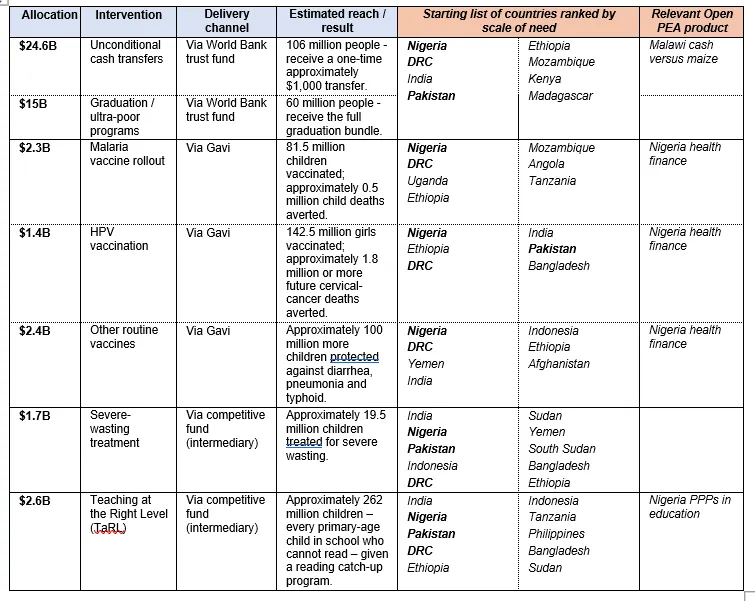
The table below starts with CGD’s proposed interventions and adds countries likely to be priorities because of the scale of need. Large, diverse countries (Nigeria, Pakistan and DRC) may require subnational products. An initial three or four products for each intervention would also offer generalisable insights even before every country has its own tailored analysis.
Adapted from Source: ‘We Can Spend $50 Billion a Year Effectively’, Center for Global Development, 27 July 2026.Adapted from Source: ‘We Can Spend $50 Billion a Year Effectively’, Center for Global Development, 27 July 2026.
An Open PEA product process costs between $100,000 and $150,000. This covers data collection, a quality assured Open PEA product, in-country and global policy convening and engagement, and advisory support and partner training as required. Updating a product would be significantly cheaper.
It would likely be most efficient to start by tackling several themes in certain high-priority countries simultaneously, and then branch out into other contexts or topics as needs dictate. This would scale PEA workstreams at pace by enabling the recruitment of topic-specific political economy specialists – health, poverty, nutrition, education – and expanding our network of country-based experts and PEA-capable think tanks.
Spillovers
This global network would be a new standing resource for understanding and managing political risks and opportunities – a very positive spillover for the development ecosystem as a whole that could increase the overall effectiveness of third-wave philanthropy, government revenue and debt, and aid and IFIs alike.
More spillovers are there to be claimed. The IMF just started a yearlong evaluation of its use of political economy. Philanthropies funding public good PEA could be a powerful way to improve IMF effectiveness – and by extension government performance – from the outside. The converse is also true – constrained aid funders could fund Open PEA to help shape the effectiveness of the third wave of philanthropy, as well as the ways that their government partners mobilise and spend domestic resources.
Our first products are proofs of concept across sectors – they demonstrate that the audience and the use case is there. Multi-year funding for packages of products could, in turn, generate better data on the cost effectiveness of PEA approaches overall and in each sector. The Open PEA core team and global network also serve as test beds for the responsible use of AI in PEA production.
Embrace the p word. And fund it!
The third wave of philanthropy needs both ‘the what’ and ‘the how’.
Open PEA would be a relatively small side bet that brings politics out of the shadows and into the mainstream of growth and development.
This can help maximise the effectiveness of the boldest, most audacious investments. Unleash the awesome.
But, like all public goods, this needs funding.
If Open PEA's mission resonates with you, get in touch at open.pea@bsg.ox.ac.uk.
There are three ways you can help.
Fund new Open PEAs (including training sessions) so we can continue developing practical, open-access analyses of the enduring problems holding education systems back.
Use our products in your own work and encourage others to do the same.
Share them widely to help put politics on the table in education policy and practice.