

THE PRACTICAL POLITICS OF
Revenue in Bangladesh
Bangladesh has a revenue crisis. Political and business elites have long used tax exemptions, discretionary enforcement and negotiated compliance to pay less than their fair share. This keeps revenue low, undermines basic services and weakens trust in the state. The government now has a narrow window for radical reform. Realigning tax administration, closing exemption loopholes and expanding the tax base from top down would cause short-term political pain, but this gamble is likely to foster long-term growth, development, resilience and a unique legacy for the BNP.
Author: Peter J Evans and Suvojit Chattopadhyay
Product No: 5
Date: October 2026
Download PDF
Table of contents
- Summary insights
- Summary propositions
- I. The problem
- II. The players
- III. The rules of the game
- IV. The state of play
- V. Our propositions
- VI. Further reading
- VII. Endnotes
About the authors
Peter J Evans is the Programme Director of the Open PEA programme. His interest in the politics of growth and development began with his PhD research on community-based malaria control in Tanzania and developed through working as a social development and governance adviser for the UK’s Department for International Development (DFID) in Bangladesh, India and Malawi. He led the DFID team commissioning governance, inclusion, humanitarian and conflict research, and designed and led the Anti-Corruption Evidence (ACE) research programme that has included a decade of research in Bangladesh. He also served as Director of the U4 Anti Corruption Resource Centre in Bergen, Norway.
Suvojit Chattopadhyay heads Adam Smith International in Africa. He brings over two decades of knowledge and expertise in governance and development and has worked extensively across sub-Saharan Africa and South Asia. Suvojit writes regularly about the political economy of development and challenges of institutional development in resource constrained environments.
Summary insights
- Bangladesh’s low tax-to-GDP ratio (6.8% in FY25) undercuts state capacity and social services.
- Over-reliance on value-added tax (VAT) disproportionately burdens middle- and low-income households. In contrast Bangladesh’s elites evade taxes equivalent to 5–6% of GDP through exemptions, statutory regulatory orders and weak enforcement in ‘prestige’ sectors.
- Elites also use the revenue system for extraction, illicit financial flows and policy capture. This undermines Bangladesh’s ‘social contract’. Since citizens don’t trust the state to use their taxes well, they are reluctant to pay and depend instead on political patronage.
- The National Board of Revenue is inefficient and politicised. Its systems are outdated, and efforts to separate tax policy and administration have been blocked. Decades of donor support for revenue reform have been technocratic, unambitious, largely blind to political constraints and undermined by those with a strong interest in the status quo.
- Recent political events changed the faces in Bangladeshi politics, but the underlying ‘elite bargain’ seems unchanged. Businesspeople have made up the majority of the last two parliaments. The BNP government’s first budget briefly considered but did not adopt a wealth tax. It deferred introducing a surcharge on the very rich, widened the compliance net at the bottom and granted fresh exemptions to industrial sectors. Despite the need for radical action, this looks like business as usual.
Summary propositions
The tax system is failing Bangladesh. Without substantial change, it is unlikely to deliver the resources needed to finance economic growth or public services. Politically smart reform would balance the urgent need for revenue generation with long-term system change that shifts Bangladesh’s elite bargain to the benefit of productive businesses and citizens. We have six propositions:
- Realign the politics of tax administration
- Measurably reduce corruption and loss within the revenue system
- Expand the tax base from top down, not bottom up, and with careful sequencing
- Ensure all technology and capacity building have political grounding and involve ‘culturisation’
- Build public trust as a priority, not an afterthought
- Ensure donors and all external partners do better
I) THE PROBLEM
Bangladesh’s revenue system (collecting income through tax, customs and other sources) bumps along the bottom on most dimensions: tax morale, equality, tax-to-GDP ratio and institutional shape.1 The problems are both economic (too little revenue is collected) and political (the revenue system has been an engine for political capture, looting and illicit financial flows).
Revenue has increasingly fallen short of expenditure over the last 20 years, resulting in rising fiscal overspend and unsustainable debt growth. If GDP growth over this period has been overstated, the structural fiscal shortfall may be even more severe. Bangladesh’s malfunctioning revenue system undermines democracy and citizens’ sense of having a stake in their country. These problems are deeply rooted in structural inefficiencies, systemic corruption and the politicisation of tax policy and administration.
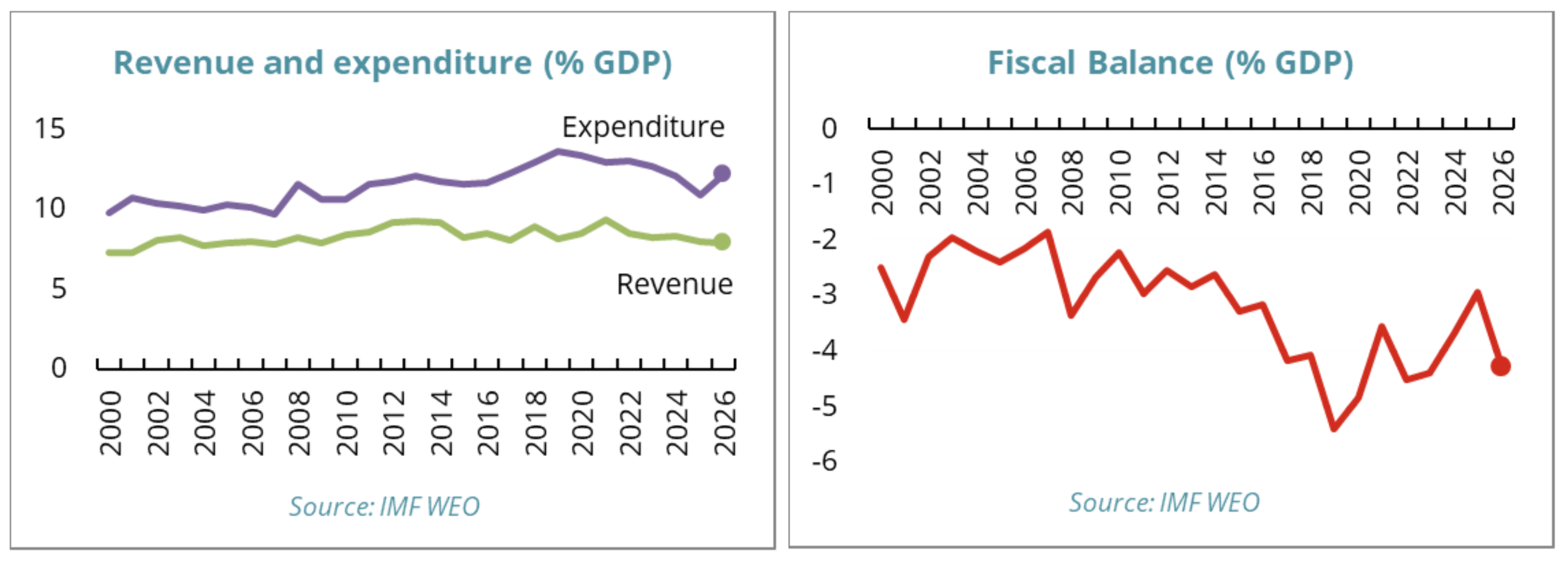
Bangladesh's tax-to-GDP ratio remains among the lowest globally, at under 7% in FY25. The government’s target in FY27 is 9.2%, but this looks unrealistic. Government failure to generate sufficient domestic revenue leaves the country dependent on borrowing and international aid to finance fiscal deficits, or it forces cuts to expenditure. In 2026, the head of the National Taskforce on Tax Restructuring similarly argued that Bangladesh’s fiscal space has effectively closed: weak revenue collection has left little surplus for development spending and forced reliance on deficit financing.2 This constrains state investment in critical infrastructure, social services and poverty alleviation, which in turn undermines long-term growth, prosperity and equality.3 Significant revenue gains are unlikely without fundamentally reforming revenue administration.
If tax cannot finance expenditure, then a government is forced to borrow. This hurts private credit. Private sector credit growth has fallen to 4.72%, the lowest in years, and investment to 27.9% of GDP.4 Bangladesh's average estimated import tax rate, close to 28%, protects domestic incumbents while penalising the diversification needed to graduate from least developed country (LDC) status. Alongside this, exemptions worth an estimated 5–6% of GDP distort competition in favour of the politically well-connected. It is more rational for firms to compete to be close to government rather than by being innovative or productive. This further constrains growth.
The revenue system is also regressive, with indirect taxes doing the heavy lifting.5 Reliance on value-added tax (VAT), which accounts for 38% of revenue, disproportionately burdens consumers. Meanwhile, Bangladesh’s elites often avoid paying their taxes. Direct taxes, including corporate and personal income taxes, contribute around 35% of revenue due to widespread tax evasion, exemptions, underreporting and weak enforcement.
The informal economy constitutes more than 40% of GDP and is largely untaxed. Sectors with strong connections to ruling parties (eg real estate, energy and financial services) benefit from generous exemptions and lax oversight. These sectors were also important in the systemic corruption, policy capture and illicit financial flows that characterised the last decade of the Awami League government.
The burden of revenue is also shaped by gender. Overall, women are less likely than men to be in formal taxable employment, though the readymade garment sector has large numbers of women in formal employment. Outside this, largescale informal work for women means reliance on indirect taxation is particularly relevant for gender equity. Bangladesh provides women with a higher tax-free threshold on personal income (Tk425,000 versus Tk375,000 for general taxpayers in 2026–27), but less visible biases may outweigh this advantage.6 World Bank research finds that high tariffs on livestock and poultry inputs disproportionately affect women, squeezing female employment and earnings.7 Any potential reforms should be checked for their specific effects on women’s employment, enterprise and formalisation, supported by sex-disaggregated taxpayer data.8
Finally, the National Board of Revenue (NBR) has chronic inefficiencies, outdated systems and limited technology. These capacity constraints are compounded by active corruption and weak enforcement, allowing businesses and individuals to evade tax with impunity. Public distrust in government discourages tax compliance as citizens perceive tax revenues to be misused or siphoned off. The visibly low quality of public expenditure on public services furthers this feeling. This creates a vicious cycle of low revenue collection, inadequate public investment and persistent inequality, further eroding trust and tax morale.9
Successful economies have typically found that ‘paying tax is the glue in the social contract’, where citizens cede some liberty and tax in return for public goods.10 But Bangladesh’s historically weak social contract has resulted in an alternative model: winner-takes-all electoral politics, politicisation of the bureaucracy and corruption. This makes it more rational for citizens to rely on patronage networks than trust the state and pay their taxes. Bangladesh’s reliance on external and domestic finance further exacerbates the under-development of the social contract and elite capture of the revenue system.11
Four developments in the first half of 2026 have made revenue reform even more urgent:
- The revenue shortfall. The NBR collected around Tk4.15 lakh crore in FY26, a record intake in absolute terms but estimated to be Tk90,000 crore short of its revised target. Against this base, the FY27 budget tasks the NBR with collecting Tk6.04 lakh crore, a 45% increase in one year. The economist Abdur Razzaque has called the target ‘not binding, but aspirational’, reflecting the general mood among analysts. In August 2026, it was reported that the NBR had missed its revenue target for the tenth consecutive year.12
- The war in the Middle East. Bangladesh has been buying fuel on the spot market at premium rates that the budget did not anticipate, adding around $3bn to energy import bills in just four months. Bangladesh normally sources around two-thirds of its natural gas from Qatar and half its imported urea from the Gulf. Domestic urea factories have been shut because of gas shortages, and the Bangladesh Chemical Industries Corporation has been forced to tender internationally to secure the 600,000 tonnes of urea needed for this cropping season. Global urea prices roughly doubled within weeks of the factories’ closures, and high fertiliser costs feed directly into food prices and the subsidy bill.
- The credit squeeze. This has worsened as the parlous state of the banking sector has been increasingly exposed.13 Non-performing loans are reported to be a third of all lending. Private sector credit growth is at a 24-year low and investment at a ten-year low.
- Deferral of LDC graduation. Bangladesh was scheduled to leave the LDC category in November 2026, but it recently asked the UN to defer graduation to November 2029, primarily at the urging of garment manufacturers. Preferential trade arrangements cover some 70% of Bangladesh's global exports, and graduation would reduce the duty-free access that aided Bangladesh’s export model. Even if deferral is granted(a UN process), industries built on preferential trade agreements will have to eventually recalibrate, and the fiscal space implicitly provided by such agreements will have to be rebuilt domestically.
II) THE PLAYERS
Bangladesh’s revenue system is shaped by powerful groups, each of which has an interest in maintaining the status quo. In this ‘elite bargain’ – the unspoken deal that determines allocation of power and resources in a country – the most influential players have been the ruling political party, their allied bureaucrats and business leaders, and segments of the middle class. For decades, the revenue system has served these groups’ relatively narrow interests at the expense of the majority. The 2024 ‘Monsoon Revolution’ dealt a blow to this political equilibrium when it pushed the Awami League out of power. But the elite bargain underlying Bangladeshi politics has survived transitions of political power before, and early evidence suggests it will again.
Political elite
In Bangladesh, the political elite controls the machinery of the state. It includes the core leaders of the ruling party and their patronage networks in government, business and society at large. Both Awami League and Bangladesh Nationalist Party (BNP) governments have used tax policies and administrative systems to serve their own interests and consolidate their power, such as through allied business associations benefitingfrom exemptions and lobbying to resist reform.14
Politicians rely on networks of mutual benefit. They grant tax exemptions and favours to influential business leaders, financiers and other supporters in exchange for loyalty, party donations and personal kickbacks. Symbiotic relationships reinforce corruption and weaken the enforcement of tax laws.
In February 2026, the BNP won a two-thirds majority and formed a government with Tarique Rahman as prime minister and Amir Khosru Mahmud Chowdhury as finance minister. Power is reported to sit with the prime minister, as indicated in deliberations over this year’s finance bill. The wealth tax was reportedly dropped on the prime minister’s instruction. Following requests made in his budget speech, the tax-free threshold was raised and the tax identification number (TIN) mandates withdrawn.15 The prime minister is party chair, which continues the Awami League’s blurring of the distinction between party and state, and centralised policy making.
Senior officials
Within the bureaucracy, senior officials of the NBR and other bodies (Ministry of Finance, Customs etc) are another powerful group. The NBR is unusual as it is responsible for both tax policy and tax administration – functions typically separated in other fiscal systems. The NBR’s politicisation runs in several directions, including the penetration of the NBR by political party interests, the power dynamics between cadres within the NBR, and the power of the NBR cadres over external politics, particularly in resisting reform.
The NBR chair has historically come from Bangladesh's elite 'administrative cadre', while NBR staff were revenue specialists from the tax and customs cadres. The new acting NBR chairman, Ahsan Habib, breaks this pattern. He was previously director general of the NBR’s Central Intelligence Cell (which investigates tax evasion).16 Like his predecessor, he is also secretary of the internal resources division at the Ministry of Finance.
The internal structure of the NBR is siloed; there is little integration or cooperation between the income tax, customs and VAT departments. The NBR has 3,500 officials and 10,000 supporting staff, some of whom exploit their discretionary powers to benefit personally from the inefficiencies and opacity of the tax system. Corruption within the tax administration is credibly reported to be systemic, with tax officials colluding with taxpayers to underreport income, manipulate customs valuations and circumvent audits.
Business community
The business community, particularly large corporations and politically connected groups in sectors like real estate, finance and manufacturing, has significant influence over tax policy. Through lobbying and political connections, they secure tax breaks, subsidies and favourable treatment from regulators. Small and medium-sized enterprises (SMEs) often operate informally to avoid taxes altogether, perpetuating a culture of evasion.
Since the election, Awami League-aligned conglomerates named in the interim government’s white paper have been under investigation, though those named dispute the charges. Some speculate that their places in the dominant elite have been taken by other business owners in real estate, garments, pharmaceuticals and banking.
Business elites in Bangladesh have long used business associations such as BGMEA, FBCCI and MCCI to influence the government. In the FY27 budget discussions, FBCCI opposed doubling the corporate minimum tax and increasing VAT on online sales, while MCCI pressed to broaden the tax base rather than increase the burden on existing payers. These chambers successfully influenced the final bill. The government withdrew the mandatory TIN requirements for new bank accounts and property mutations, raised tax-free thresholds by Tk50,000 to Tk4 lakh, and withdrew provisions for investment-disclosure.
Global Financial Integrity estimated that Bangladesh lost around $68bn to trade misinvoicing between 2013 and 2022 – an average of $6.8bn a year, or roughly 16% of total trade.17 Such losses require the participation of officials as well as traders, and accordingly the Centre for Policy Dialogue found that 45% of firms report being asked for a bribe by tax officials.18 Misinvoicing, exemptions and selective enforcement are part of a sophisticated mechanism of corruption.
International agencies
Multilateral banks and bilateral donors may regard themselves as neutral observers, but they are active players in the political economy of Bangladesh’s revenue system. Arguably, their habit of bringing technical tools to a political game unwittingly perpetuates dysfunction. For example, a narrow focus on revenue yields or digitisation may prompt vested interests in revenue administration and their political patrons to actively undermine reforms.
The IMF withheld the sixth tranche of Bangladesh’s last programme as elections approached. The new government chose to negotiate a new IMF programme, and Finance Minister Khosru said publicly that the old conditions – uniform 15% VAT, elimination of exemptions and replacement of universal subsidies with targeted transfers – are not suitable for Bangladesh. He also said that an elected government cannot comply withdemands that challenge its democratic mandate. After deliberations with the IMF mission in Dhaka in July 2026, Khosru announced that the IMF had ‘agreed with the government's phased reform plan’.19
This is very different to the old programme. The IMF has named four priorities: reducing subsidies, restructuring the banking sector, modernising tax administration and delaying the introduction of a new public sector pay scale. The separation of tax policy and administration – a condition of the previous programme – has been dropped. When an IMF delegation met the NBR’s acting chairman on 28 July, the agenda was an automation roadmap and the unification of separate income tax and VAT identification numbers – a recommendation the IMF has made since 2005. Attention appears to have shifted from structural reform back to more technical fixes.
The middle class
Bangladesh’s middle classes have a resistance to paying taxes justified by distrust in government spending and frustration with opaque tax systems and burdensome compliance. This resistance is both a cause and a consequence of broader governance and political failures. It is an open question whether the collective capacity shown in the Monsoon Revolution could be harnessed toward building tax morale and accountability.
III) THE RULES OF THE GAME
Formal rules and structures relating to revenue are set out in laws, regulations and institutional frameworks, including the Income Tax Act, the VAT Act and customs regulations. These establish the legal basis for tax collection and enforcement, and penalties for non-compliance. The NBR administers these laws, overseeing direct and indirect taxes, and ensuring compliance.
The formal rules are overshadowed by informal rules, which govern how the revenue system operates in practice. At the heart of these informal rules are the politicisation of tax policy and administration, with negotiated compliance reported to be common.20 Tax exemptions, selective audits and discretionary enforcement are common, reflecting the influence of political interest over economic rationality. As noted above, successive governments have used the revenue system to consolidate power, reward allies, punish opponents and benefit personally. The high number of businesspeople in parliament (the Jatiya Sangsad) makes any move towards higher tax rates or fairer tax collection difficult.
Discretion also shapes the development and adoption of new formal rules. Business groups, politicians and officials often bend policy in their favour, particularly through excessive use of statutory regulatory orders. SROs are administrative instruments used to modify tax laws, grant exemptions or introduce measures without legislative approval. Some are justified, but their excessive use has become a tool for distributing political favours, with the energy sector offering some particularly egregious examples during the Awami League era.21
SROs can undermine transparency and predictability, distort trade and massively reduce revenue. By making legal what was previously illegal in the interests of elite groups, they also constitute ‘policy capture’ and arguably ‘state capture’.22 SROs typically have no time limit (‘sunset clause’), therefore exemptions are perpetual. The interim government understood this and shone a critical spotlight on the misuse of SROs by the Awami League. Nevertheless, when the Finance Act was passed in July 2026, the NBR issued a large number of SROs and general orders to accompany it. They remain a favoured instrument.
Corruption distorts the application of the formal rules. Tax officials often solicit bribes in exchange for favourable treatment, such as reducing tax liabilities or ignoring irregularities.23 This creates a parallel system where compliance is determined not by adherence to the law, but by the ability to navigate informal networks and make appropriate payoffs. Businesses and individuals who can afford to do this rarely experience the full weight of the tax system. Those who cannot, or will not, bear the brunt of enforcement.
Elites and politically connected individuals resist reforms (eg transparency measures) that challenge their ability to exploit manual processes for tax evasion, exemption and corruption. At the same time, successive governments have prioritised short-term political gain over long-term reform. For example, politicians are reportedly wary of digitisation because they fear it could expose systemic corruption, inefficiencies and high-profile tax evasion. Institutional entrenchment within the revenue agencies creates further resistance to reform. Politically appointed officials fear losing the discretionary power and illegal income streams associated with manual systems.
Another informal rule is the widespread acceptance of tax evasion as a norm. Both businesses and individuals view underreporting income or avoiding taxes as a rational response to an inefficient and corrupt system. This culture of non-compliance is reinforced by weak enforcement mechanisms, which fail to hold violators accountable.
IV) THE STATE OF PLAY
The risk of any political economy analysis is that every problem is attributed to dynamics such as ‘elite capture’. This may understate the genuine administrative problems in a complex system like Bangladesh’srevenue machinery. Political incentives help explain why many of these problems persist, but it should be seen as a complement to technical analysis – not a substitute for it.
The result of the political realities described above is a revenue system that was described during the interim government period as ‘policy chaos’.24 Revenue administration is sclerotic and captured, but not irrational: it is part of a wider elite bargain that serves elite interests rather than the economy, citizens or national resilience.
Revenue extends beyond tax collection: VAT, customs and other sub-systems shape trade, growth, balance of payments and citizen-state relations. Weak revenue constrains essential services and infrastructure, deepens deficits and increases debt-servicing costs. In the FY27 budget, a total outlay of Tk9.38 lakh crore includes a projected deficit of Tk2.43 lakh crore. Technical weaknesses matter. But decades of technical reform have obscured the root causes: politicisation, capture, discretion and corruption. Politics repeatedly resists or undoes reform.
One step forward, two steps back
The interim government’s May 2025 ordinance divided the NBR into revenue policy and revenue management divisions. This is technically sensible, but the change was introduced without adequate consultation or coalition-building. It prompted a strike by NBR officials that paralysed import and export clearance. A revised ordinance in September guaranteed that revenue officials would lead management, and macroeconomic and trade experts would lead policy. This preserved much of the discretion the original reform sought to dismantle. Approved by the advisory council shortly before the election, the ordinance was challenged in court on 1 February 2026. It lapsed after parliament failed to ratify it within the constitutional one-year window.
Brave thoughts + meek action = business as usual
The BNP’s FY27 budget process suggests that bold reform is discussed but then dismissed. For example, a wealth tax received preliminary approval in May but was dropped before the budget was read. Similarly, aproposed surcharge on the highest earners was deferred until FY28 and narrowed to incomes above Tk3 crore, rather than the Tk1 crore recommended by the NBR. An inheritance tax was also discussed but not adopted.
These reforms could have helped reshape the elite bargain gripping the revenue system. Instead, they appear to have stalled because there was no political strategy to overcome the immediate costs imposed on influential groups. Government, think tanks and civil society all need to move beyond just identifying the economically sensible and help construct the politically possible.
While retreating from taxation at the top, the government sought to widen the base by making business identification numbers mandatory for corporate credit, trade-licence renewal, utility connections, vehicle registration and commercial mobile-money accounts. This looks worryingly like business as usual.
The revised Finance Bill 2026 retained numerous sectoral tax holidays and added new duty concessions. In the 29 June budget speech, the prime minister proposed tax and duty relief for products ranging from shrimp and copper to LED lamps and prefabricated buildings; all were accepted.25 An immunity for undeclared money invested in real estate was withdrawn at committee stage on the prime minister's recommendation. Exemptions continue to be issued, usually without time limits. The mechanisms by which politically connected sectors secure privilege remain intact.
In August 2026, the NBR proposed a National Income Tax Data Matching System that would assemble taxpayer profiles from bank transactions, property and vehicle ownership, company holdings and foreign travel.It also proposed a High-Net-Worth Individual (HNWI) Unit (or a greater focus on HNWIs by the existing Large Taxpayer Unit), and overseas customs attachés to detect misinvoicing. These are substantial technical reforms, but they will work only if accompanied by measures that constrain official discretion.
The current government appears determined to chase down the previous regime’s illicit wealth and its preferred mechanism is by using the law for asset recovery. In May 2026, Finance Minister Khosru announced that assets worth Tk72,343 crore had been seized or frozen at home and abroad.26 However, it shows less interest in preventing future illegal accumulation.
Making sense of this
Too much should not be read into a single budget, particularly the BNP's first in 17 years. At the same time, much of the wealth that new taxes could reach was accumulated under the Awami League regime. Prosecuting former regime figures and recovering their assets therefore makes more political sense than broad taxes that could alienate the BNP's own business allies. Low investment and difficult macroeconomic conditions also make taxing capital harder.
Nevertheless, a narrow window for reform may exist. The immediate priorities are separating tax policy from administration within the NBR and reviewing the SRO mechanism. These could be followed by measures to both recover stolen assets and prevent future illegal accumulation. None of these necessarily contradicts the democratic mandate that the government invoked when negotiating with the IMF.
Taxing prestige sectors associated with the BNP's core support base may be out of reach this year. But if the NBR continues to miss its targets, reform may become unavoidable. The government could announce now that tax holidays and concessions in these sectors will be reviewed against transparent criteria and progressively withdrawn according to a clear timetable – in effect, putting allies on notice that the national interest needs to take priority.
The political calendar provides a practical timeline. The IMF programme, expected to be finalised in October 2026, offers an external framework in which credible commitments can be embedded and defended as necessary for national financial health. Deferring LDC graduation to November 2029 provides a second milestone around which domestic constituencies can be mobilised. With the next general election expected in early 2031, there is roughly a three-year window from late 2026 to late 2029 for significant structural reform.
There is time for the government to construct a viable win-win transition: shifting revenue politics towards growth, development and prosperity without creating an electoral millstone. The alternative is more policy chaos and the return of the risks that brought down the Awami League.
V) OUR PROPOSITIONS
Bangladesh's extreme and entrenched revenue problems endure despite decades of reform efforts. This should be a stern warning against any more technocratic business as usual. External support that ignores history, politics and context risks complicity in the system's recapture. Yet the overlapping fiscal squeeze, inflated import bill, revenue shortfall, falling investment and pressure for more public spending create opportunity for more radical reform. The BNP has a mandate to 'fix' the Awami League’s damage and, temporarily, can attribute some of the resulting pain to this problematic inheritance.
However, reform needs a political strategy for shifting the revenue system’s long-term elite bargain. Leaving it intact will perpetuate the crises. The BNP will have to take calculated risks with its supporters' short-term interests, weaning them off tax privileges that can look indistinguishable from corruption. In return, these networks need confidence that sensible reform creates a path to credible future gains (through productive effort rather than free passes).
Revenue reform could be recast as a patriotic state-building project by linking tax payment to citizen-state relations, accountability for public spending and a shared national future. This could engage business elites, citizens, civil society and Bangladesh's international partners. Former prime minister Sheikh Hasina offered a version of state modernisation, but used unreliable GDP data and a veneer of digitisation as a cover for looting the economy and violently suppressing opposition. The new BNP government could offer a future grounded in fact rather than fantasy.
Revenue reform should explicitly address both its political and technical dimensions and the wider system in which revenue operates.27 This means weakening dynamics that enable capture, impunity, inequality and tax evasion, while positively reinforcing the linkages between direct taxation, trust, tax morale, service delivery and the social contract. This requires balancing urgent measures to close the revenue gap with a long-term strategy for changing the system.28 Short-term revenue collection alone will not shift the existing equilibrium or build resilience.
Political and business elites will continue to influence revenue policy even after reform. The aim is not to eliminate that influence, but to constrain it by building a bargain where growth, revenue, services and political legitimacy reinforce one another. Egregious corruption must be investigated but provided their behaviour changes, Bangladesh will likely need to retain most of its current revenue officials. The NBR cannot punish its way forward, and is unlikely to do so.
Decades of institutional degradation have also left the NBR with weak capacity. It needs greater autonomy, but of function – not accountability. Before such autonomy is granted, it needs the right mix of personnel and a clear separation between revenue policy and administration – and between legitimate enforcement and patronage. These reforms are both important and urgent.
We have six propositions to address the political constraints to revenue mobilisation and supporting growth, services, resilience and a stronger social contract. All depend on putting politics firmly on the policy table.
Proposition 1. Realign the politics of tax administration – with a vision
Depoliticising tax administration is a worthy goal, but the resilience of opposing interests throughout the 2024 revolution, the interim government and the election suggests that realigning politics is more realistic. Bangladesh's elite bargain will continue to shape tax administration, but appointments, audits and enforcement can be progressively insulated from patronage. Merit-based recruitment and promotion and more transparency will need clear political support from the top of government, and public acknowledgement of how capture operates, a commitment to prevent its return and problem-solving experimentation rather than imported technical solutions. International experience with protected 'pockets of effectiveness' may help.29
This realignment should start now, before another round of technical reform. Executive action should establish merit as the basis for appointments, audits and enforcement, while recognising that capture will seek new routes back into the system. That commitment should form part of a credible political and electoral strategy for the BNP, be designed to extend beyond the current government, and be made public so that government can be held accountable. The July Charter demonstrated support for institutional reform but did not resolve tax administration. Although the BNP has not committed to implementing the charter, it could make its own compact for helping Bangladesh escape its present crises and become more resilient. This would offer civil society a cogent vision – political and technical – around which to mobilise and engage.
The policy-administration split is clearly an option following Finance Minister Khosru's June statement that the NBR would be divided into policy and implementation wings, with tax policy set by an expert group rather than bureaucrats.30 The change could be settled by fresh legislation drafted with both revenue and administration cadres at the table. This would reduce uncertainty over reporting lines and careers, while confirming the government’s intent and timeline for change. The government could embed this legislation in IMF programme negotiations as a credible revenue commitment, and civil society could help ensure that the finance minister’s words become reality.
Proposition 2. Measurably reduce corruption and loss within the revenue system
Automation, simpler processes and stronger internal controls can reduce discretion in filing, assessment and audit. But officials and taxpayers will adapt, collude and find ways around reform. Anti-corruption is a continuous struggle, not a one-off intervention: government must pursue cases while constantly redesigning systems to prevent new ones.31 Stronger internal accountability and credible penalties remain necessary, but neither will be sufficient on its own. Political economy analysis like this Open PEA product should track how officials, elites and taxpayers respond to each reform. This allows government to close emerging loopholes rather than wait for a new pattern of loss to become entrenched.
A concrete priority is shutting down abuse of SROs. SROs can grant benefits to particular interests with little scrutiny, and the resulting exemptions are estimated to cost Bangladesh around 5-6% of GDP (though such tax expenditure cannot simply be turned into collected revenue). Not all SROs are evidence of capture – they can address real problems such as cascading taxation and export barriers. But they should be subject to routine and transparent cost-benefit tests, and assessments of who receives them, why, and what economic benefits they produce. Time limits on SROs should also be mandatory. Exemptions above a defined threshold should be published, justified and subjected to independent scrutiny. Existing SROs should be reviewed, and the forgone revenue reported annually in a tax-expenditure annex to the budget. This would implement the NBR's own commitment to reduce exemptions.
Officials losing discretion and businesses seeking preferential treatment will resist SRO reform. But the government will gain revenue without new or higher taxes – and a way to dismantle machinery associated with the Awami League. The harder test will be applying the same discipline to interests associated with the current government. These sectors should be clearly put on notice that change will come before the next election, and that this is a national, even patriotic, duty.
Proposition 3. Expand the tax base top-down, not bottom-up, and with careful sequencing
Formalisation should use simple registration and incentives, but proceed cautiously. Many informal businesses fall below plausible tax thresholds and sustain poor households. Sequencing is key – premium sectors and high-net-worth individuals should be addressed first, and the informal economy later. Among those already within the tax net, non-filing has different causes. Some businesses have ceased trading and should be removed from the register; others are avoiding liabilities. Treating both groups the same inflates apparent coverage, wastes enforcement capacity and risks imposing new costs on people with little ability to pay.
The real estate, luxury goods and digital business sectors offer scope for direct taxation, and are concentrations of influence, impunity and criminality. Tax investigations can be used to expose wider criminality, but positive persuasion also matters.32 Dedicated tax research and high-net-worth individual units have delivered results in difficult settings, including Uganda. Success in Bangladesh depends on a future elite bargain that expects rich citizens to pay their dues.33
Conditions for top-end enforcement appear unusually favourable. The government had seized or frozen Tk72,343 crore by May 2026, and the new NBR chair previously led its tax-intelligence wing. Bangladesh has the investigative capacity and political cover needed to examine current wealth accumulation as well, not only assets accumulated under the previous regime.34 Yet the FY27 budget widened the net at the bottom through mandatory business identification numbers and a retailer advance tax while dropping the wealth tax and deferring the high-income surcharge. These measures are unlikely to meet the government's targets. The IMF and other partners should press for action on premium sectors and HNWIs first, informal economy later.
In the medium term, Bangladesh cannot build a modern revenue system around HNWIs and a few prestige sectors. The objective must be broad-based formalisation, a functioning VAT system, stronger personal income taxation, rationalised corporate taxation and much better integration of tax, property, banking and business-registration data. The priority for sustainability is sequencing, not choosing between taxing elites or broadening the base.
Proposition 4. Politically ground technology and capacity building
Technology and training can improve efficiency, transparency and enforcement, but only where political incentives support their use; otherwise vested interests will disable or capture them. Digitisation is therefore more likely to work as part of a broader effort to build a new culture within the NBR and reshape the elite bargain around it.
Capacity building should therefore involve 'culturisation' as well as equipment and skills. The goal is to create expectations that officials will serve taxpayers, use information consistently and resist informal deals. Training can strengthen enforcement and service, but only when career incentives, leadership and accountability reinforce the behaviour being taught. History demands caution: vested interests undermined earlier digitisation even as it became a flagship of the Awami League's arguably hollow modernisation efforts. International organisations supporting the programme risked complicity in that illusion, with procurement irregularities also alleged.35
The pattern may be repeating. In July 2026 the IMF pressed the NBR to unify income-tax and VAT identification numbers into a single taxpayer ID – a technical recommendation under discussion since 2005. Officials argued that immediate implementation was infeasible because of weaknesses in networks, databases and infrastructure. Each objection may be reasonable, but a 21-year delay signals political, not merely technical, constraints.36
External partners should therefore sequence support. Legislation separating NBR policy from administration and concrete SRO reform should demonstrate political commitment before another tranche of technical systems investment is financed.
Proposition 5. Build public trust as a priority, not an afterthought
Trust will grow only if taxpayers see fair treatment and tangible returns. The government should involve revenue officials, tax professionals and civil society in reform. It should publish plainly what it collects and buys, and link compliance to visible local health and education services. Evidence-based communication can support this effort: a growing tax-research literature tests how individual and public messages affect trust, tax morale and actual revenue.37 But revenue cannot do this alone – the quality of public expenditure and the quality of basic services are also important for building trust. Raising the tax-to-GDP ratio without improving the effectiveness of expenditure may enlarge the state without strengthening the social contract.
The new government will need to engage the tax bureaucracy without allowing it to veto change. Including officials, tax professionals and civil society in deliberations can reduce resistance and broaden scrutiny, while transparency over revenue and spending can give these groups something concrete around which to organise. Asset recovery must follow due process and not appear as a partisan witch hunt. Data from property records, banks, asset registers and digital payments will improve compliance only if it citizens see it reducing discretion rather than creating new opportunities for extraction. Applying the system first to those best able to evade it would build trust; imposing visible new burdens on those least able to resist would destroy it. The FY27 decision to drop the wealth tax while widening the base put this sequence in the wrong order.
Trust will also suffer if reforms worsen household welfare. Consumption-tax increases without stronger social protection are regressive, whatever their macroeconomic logic. Reform should be tested for gendered effects: burdens on women-owned microenterprises; the relationship between garment-sector exemptions, wages and working conditions for a predominantly female workforce; and whether revenue and exemption data can be disaggregated.
Proposition 6. Ensure donors and external partners do better
International partners can support reform and help shore up Bangladesh's economy, but politically naive technical assistance risks doing harm. The government has exited the Awami League-era IMF programme and requested a new $5bn programme, while challenging the old programme's uniform-VAT and exemption-elimination conditions. Negotiations expected to conclude in October 2026 provide leverage to secure a few structural commitments: a legislated NBR split, annual tax-expenditure reporting and time limits on SROs. These would be more valuable than revenue targets that can be fudged, missed and ultimately waived. Deferring the difficult reforms again would leave the underlying tax politics unchanged.
While reform requires domestic ownership, external partners can become more intentionally politically informed. They should: stop presenting improvements in form, such as digitisation, as success; support and help build the political case for reforms that affect entrenched interests; and publicly assess whether technical investments are really challenging discretion and changing incentives and behaviour. This includes helping settle disputes between revenue cadres, helping close routes for illegal wealth accumulation and building trust through fair asset recovery and transparent tax expenditure. This requires behavioural change. Partners should be willing to fund the politically difficult work around SROs, cadre interests and high-end evasion, and resist declaring success because a platform has been launched or a training programme completed. Their reporting should distinguish institutional form from changes in who benefits, who decides and who is held accountable.
Better data and analysis only help after a political decision to act; technical experts and tools cannot solve political problems. Open-source political economy analysis – including annual updates of this paper and monitoring of major revenue programmes – would help external partners and domestic actors distinguish genuine change from another cycle of technical activity. Putting politics permanently on the tax-policy table will require courage. But it is the essential condition for making the other investments work.
VI) FURTHER READING
- Eusuf, M.A. (2024) ‘The illusive goal of domestic revenue mobilisation’, Chapter VI in: Bhattacharya, D. et al (2024) ‘White paper on state of the Bangladesh economy – dissection of a development narrative’, Government of Bangladesh, draft, November.
- Chowdhury, A. and A. Aman (2023) ‘Why does Bangladesh tax so little?’, IGC Blog, International Growth Centre, 3 April ⧉.
- Hassan, M. and W. Prichard (2013) ‘The political economy of tax reform in Bangladesh: political settlements, informal institutions and the negotiation of reform”, International Centre for Taxation and Development (ICTD), Working Paper 14 ⧉.
- National Board of Revenue (2025) ‘Medium- and long-term revenue strategy FY2025-26 to FY2034-35’, Government of Bangladesh ⧉. This contains the government's own stated reform commitments, against which progress can be measured.
- Centre for Policy Dialogue (2026) ‘Corporate income tax reform for graduating Bangladesh: the justice perspective’, May ⧉. Based on survey and financial data from over 100 firms.
- Khatun, F. (2026) ‘Bangladesh economy in 2025 and expectations for 2026’, Centre for Policy Dialogue, 1 July ⧉.
- International Centre for Tax and Development (2026) ‘Taxing smarter: advancing reform through research and partnership’, Brighton: Institute of Development Studies, July ⧉. This is a synthesis of fifteen years of research across lower-income countries.
VII) ENDNOTES
- Tax-to-GDP ratio stood at 6.8% of GDP in FY2024–25. The government plans to raise it to 9.2% in FY2026–27, against a target of 8.6% in the revised FY26 budget. See: Byron, R.K. (2026) ‘20 percent higher revenue target for next year’, The Daily Star, 11 May ⧉.
- Zaidi Sattar warned that with the revenue shortfall leading to a net deficit of Tk1.05 lakh crore during July 2025–February 2026, the government would be forced to borrow to finance the annual development programme. See: Zaman, A. (2026) ‘Missed targets: NBR needs Tk2.6 lakh crore by June to avoid shortfall’, The Daily Star, 22 April ⧉.
- The poor quality of public expenditure – planning, implementation, corruption in public procurement and contract delivery, and low-quality services – is as important a constraint as low revenue flow.
- For private sector growth, see: Hasan, M. (2026) ‘Private sector credit growth falls to 33-year low’, The Daily Star, 5 August ⧉; For investment, see: Kabir, H. (2026) ‘Govt targets lofty 34.5pc investment-GDP ratio for FY27’, The Financial Express, 22 August ⧉.
- In July–March FY2025–26, domestic VAT contributed 38% of collection (Tk1.09 lakh crore), direct taxes 33.5% (Tk98,501 crore), and import tariffs Tk80,223 crore. See: Zaman, A. (2026) ‘Missed targets: NBR needs Tk 2.6 lakh crore by June to avoid shortfall’ ⧉.
- National Board of Revenue (2026) ’Budget speech 2026–27’, Government of Bangladesh ⧉.
- Koolwal, G. and B. Haven (2024) ‘Gender and trade policy: how agricultural tariff reform can support rural women in Bangladesh’, World Bank Blogs ⧉.
- Niesten, H.M.L., L. Ferraz Di Ricco and A. Sakhonchik (2026) ’Gender and taxation: insights from new data across 81 economies’, Policy Indicators Briefs, 41, World Bank ⧉. This contains sex-disaggregated tax data and assessing gender effects of tax policy and administration.
- Chowdhury, A. and A. Aman (2023) ‘Why does Bangladesh tax so little?’, IGC Blog, International Growth Centre, 3 April ⧉.
- Rousseau, J-J. (1762) The Social Contract; See also : Cobham, A. (2022) ‘Taxing for a new social contract’, F&D Magazine, IMF ⧉.
- Bangladesh’s debt is more domestic than external. See chart 1 in: World Bank (2023) ‘Bangladesh: joint World Bank-IMF debt sustainability analysis’ ⧉.
- Zaman, A. (2026) ‘NBR misses revenue target for 10th straight year’, The Daily Star, 5 August ⧉.
- Non-performing loans are reported at around 30% of lending. See: The Daily Star (2026) ‘Economic outlook fragile as country faces three-pronged crisis: PRI’, 24 April ⧉.
- It is important to note how well-established this elite bargain is. For example, this paper from 2013 is still remarkably accurate: Hassan, M. and W. Prichard (2013) ‘The political economy of tax reform in Bangladesh: political settlements, informal institutions and the negotiation of reform’, Working Paper 14, International Centre for Taxation and Development (ICTD) ⧉.
- Mala, D.A. (2026) ‘PM directs dropping wealth tax, money whitening’, The Financial Express, 4 June ⧉.
- Ahsan Habib, a 15th batch officer of the income tax cadre and previously director general of the NBR’s central intelligence cell, was appointed acting chairman of the NBR and acting secretary of the Internal Resources Division on 29 June 2026, replacing Md Abdur Rahman Khan. See: bdnews24.com (2026) ‘Government appoints Ahsan Habib as acting NBR chairman’, 29 June ⧉.
- For Global Financial Integrity’s trade misinvoicing estimates for Bangladesh, 2013–2022, see: The Daily Star (2026) ‘An alarming record of trade misinvoicing’, 31 March ⧉.
- Ahmed, T. et al (2025) ‘Corporate income tax reform for graduating Bangladesh: the justice perspective’, Centre for Policy Dialogue ⧉.
- The Daily Star (2026) ‘Reforms under IMF programme to be phased in – Finance minister says’, 14 July ⧉.
- Ahmed, S. (2024) ‘Institutional dimensions of tax reforms in Bangladesh’, in Raihan, S, F. Bourguignon and U. Salam (eds.) Is the Bangladesh paradox sustainable? the institutional diagnostic project, Cambridge University Press:185-217 ⧉.
- The white paper states: ‘The excessive use of SROs has become a tool for distributing political favours, undermining the effectiveness of Bangladesh’s tax policies. Although not exhaustive, Table 6.1 provides a brief overview of granted to selected large conglomerates.’.
‘Policy capture’ means that public decisions over policies are consistently or repeatedly directed away from the public interest towards a specific interest. See for example OECD (2017) ‘Preventing policy capture: integrity in public decision making’ ⧉. For a definition of ‘state capture’, see for example Dávid-Barrett, E. (2023) ‘State capture and development: a conceptual framework’, Journal of International Relations and Development, 26, 224–244 ⧉. On SROs, consider the following: ‘a review of customs duty–related SROs issued between FY2015 and FY2019.
As many as 926 SROs were introduced, each aimed at providing a special benefit to a target group.’ And ‘In most cases, these special treatments were allowed as a response to political lobbies by the beneficiary group. There are similar SROs related to income tax, the VAT, and regulatory/supplementary duties. The SROs are also a good illustration of the absence of systematic tax policy analysis. The SROs are mostly introduced to benefit politically well-connected groups: there is almost no concern about what this does to resource allocation or tax collection. This ad hoc approach to tax policy and tax administration is a serious problem that must be addressed in order to modernise the tax system in Bangladesh.’ From Ahmed, S. (2024) ‘Institutional dimensions of tax reforms in Bangladesh’ ⧉.
- According to the Centre for Policy Dialogue, 45% of private companies surveyed stated that they were asked for a bribe by tax officials in financial year 2023. See: Ahmed, T. et al (2025) ‘Corporate income tax reform for graduating Bangladesh: the justice perspective’ ⧉.
- Bhattacharya, D. et al (2024) ‘White paper on state of the Bangladesh economy – dissection of a development narrative’, Government of Bangladesh, draft, November 2024. p. 88.
- For PM Rahman’s tax proposals, see: The Business Standard (2026) ‘PM calls for withdrawal of black money legalisation provision in proposed budget’, 29 June ⧉.
- This involved eleven priority cases up to May 2026, with 23 mutual legal assistance requests sent to 13 countries, and recovery agreements finalised with Malaysia and Hong Kong.
See Evans, P. (2025) ‘Picture this 3: Bangladesh Revenue System’ ⧉.
Image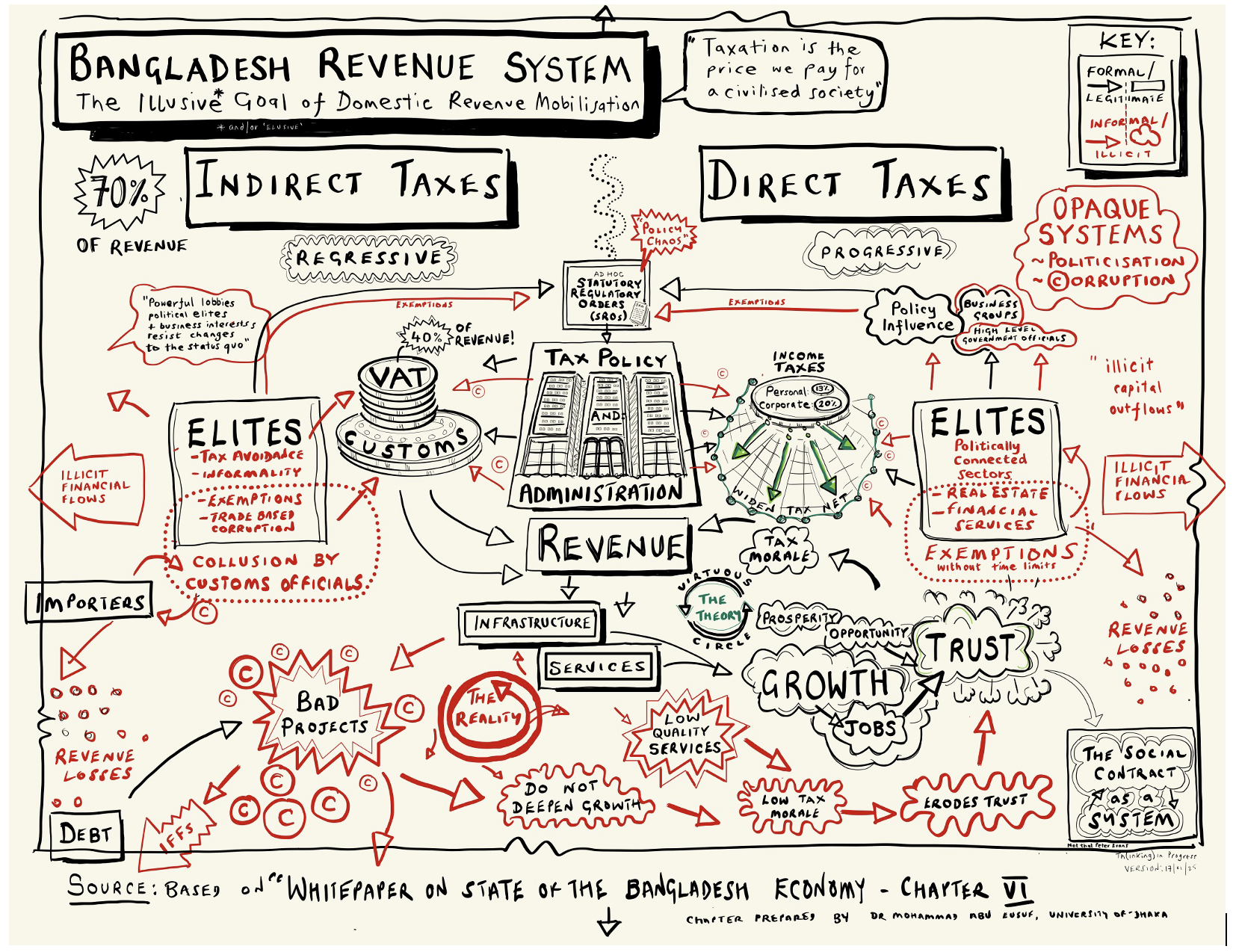
- Increasing VAT is attractive because it is a familiar lever capable of generating relatively predictable revenue from an established tax base. Broadening the tax base is more complex and encounters additional structural and political-economy obstacles in both design and implementation. Both are necessary: immediate reliance on VAT should not displace the harder task of broadening the base.
- ‘Pockets of effectiveness’ are public organisations that provide public goods and services effectively despite operating where effective public service delivery is not the norm. They have proved important to developmental-state success in the Global South.
- Speaking at a CPD dialogue on 21 June 2026, the finance minister said the government would split the NBR into separate policy and implementation wings, and that an expert group rather than bureaucrats should design tax policy. The Business Standard (2026) ‘Govt to split NBR into policy and implementation wings: Khosru’, 21 June ⧉.
- For the use of ‘whack-a-mole’ in anti-corruption strategy, see David-Barrett, E. (2020) ‘Anti-corruption in Aid-funded Procurement: Whacking the Mole is Not Enough’ ⧉.
- See US National Archives, ‘The Taxman Cometh: U.S. v. Alphonse Capone’ ⧉.
- See, for example, the case of Uganda: International Centre for Tax and Development (2016) ‘Bringing Uganda’s rich into the tax net’ ⧉.
- Byron, K.B. (2026) ‘No easy return for bank plunderers’, The Daily Star, 30 June ⧉.
- For alleged irregularities in procurement, see: Afrin, S. (2024) ‘3 companies got majority of work with dominance of 1 person’, Prothom Alo, 13 November ⧉.
- Dhaka Tribune (2026) ‘Unified taxpayer data: IMF hands NBR new automation roadmap’, 28 July ⧉. NBR officials noted that the IMF had been making this recommendation since 2005.
- Moazzem, K.G. et al (2026) ‘Tax justice for graduating Bangladesh: the case of corporate income tax and value added tax’, Centre for Policy Dialogue, March ⧉.